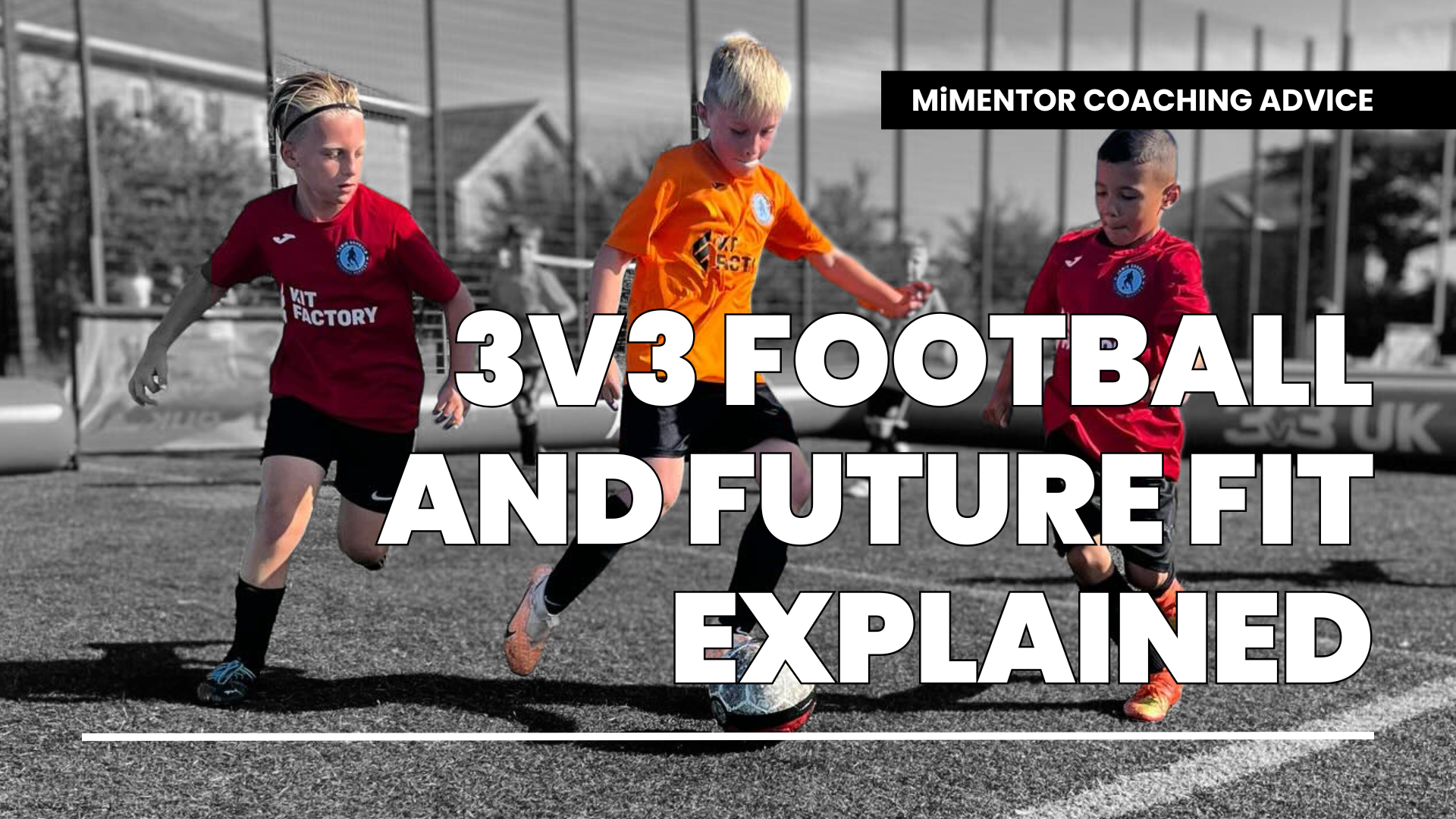
3v3 isn’t just a new format, it’s a shift in how young players learn, improve, and love the game.
From the 2026–27 season, the The Football Association will introduce mandatory 3v3 football as the entry format for all U7 players in England.
As grassroots clubs prepare for this shift, coaches are asking: Why 3v3? What does it mean for my sessions, my players and our club? And how can we prepare in a way that drives development?
This article answers these questions with insight from elite football development research, practical coaching experience, and key resources designed to support this transition.
Setting the Scene: Why The FA Is Making Changes
The FA’s Future Fit initiative aims to improve grassroots youth football by prioritising technical engagement, increase players' time with the ball, and active decision-making from the first days players step onto a football pitch.
Traditionally, young players have begun competitive football in formats such as 5v5 or 7v7 before eventually progressing to 11v11. However, research from leading academies and performance programmes shows that smaller-sided games dramatically increase meaningful involvement in play, which accelerates skill development.
One study from the Science and Medicine in Football Journal showed that players involved in 3v3 small-sided games experienced up to twice as many ball involvements per minute than in larger formats. (Source: SMF Journal – Small-Sided Games Research)
This shift reflects a growing global trend: coaches and national associations are increasingly relying on small-sided games to develop football intelligence, technical ability and confidence before introducing larger tactical frameworks.
The Future Fit timeline is structured to support a smooth rollout:
● 2025/26 season: Early adopter festivals and pilot programmes focused on 3v3.
● March 2026: FA digital conferences and guidance material released for clubs.
● September 2026: 3v3 becomes the mandatory entry format for all U7s across England.
What The Changes Are, And The Impact on All Age Groups
Core elements of the FA’s new 3v3 format
The FA recommends specific structural adaptations for grassroots clubs:
✓ 3v3 teams: three players on each side
✓ No goalkeepers: goalkeepers are introduced later in the pathway
✓ Small pitches (~10m x 15m): up to four pitches can fit inside a single 5v5 space
✓ Adult supervision: matches do not require referees
✓ No competitive results or league tables: learning and enjoyment are prioritised
These changes are designed to ensure young players maximise touches, decisions and engagement — but their knock-on impact extends beyond U7s.
Impact on age groups up the pathway
Future Fit also adjusts progression through the development model:
● Larger formats (7v7, 9v9, 11v11) are introduced progressively as players mature.
● The goal is to spend more time in small-sided games during the early stages where skill acquisition is most impactful.
● As players grow, they transition into larger formats with a strong foundation of technical ability and game understanding.
This reflects long-standing pedagogical principles: children learn best through active engagement, repetition, and relevant challenge.
The Benefits of the 3v3 Format
1. Players Get More Ball Time
Because there are fewer players, each one has more opportunities to touch the ball — as often as twice as many touches per minute compared with 7v7 or 5v5. More touches = more practice under real pressure = faster skill development.
2. Technical Skills Are Accelerated
In 3v3, players are consistently involved. This means:
► More dribbles
► More passes
► More receiving under pressure
► More decisions in attacking and defending
This mirrors how elite academies use small-sided games to improve core football skills before introducing complex tactical structures.
3. Speed, Agility and Movement Improve Naturally
Because players must constantly move into space, they organically develop:
● Acceleration
● Balance and coordination
● Change of direction skills
● Awareness of the ball and opponents
These physical qualities are essential for long-term football development.
4. Decision-Making and Game Intelligence Are Sharpened
With only three teammates and three opponents, every player must think, adapt and react, not just physically, but cognitively.
This leads to faster development of:
✓ Game awareness
✓ Spatial recognition
✓ Support angles
✓ Timing of runs and passes
This is one reason nearly every professional academy uses 3v3 or 4v4 formats as part of training.
5. Emotional and Social Benefits
Smaller formats also help children build:
● Confidence through frequent involvement
● Communication with teammates
● Love for the game through fun, engaging play
The psychological aspect is especially crucial in early years development.
Common Concerns and Questions Answered
While the benefits are clear, many coaches are raising questions about logistics, squad management, and implementation.
Logistics and Facilities
Q: Where will we fit all the 3v3 pitches?
The FA recommends that up to four small 3v3 pitches fit inside one 5v5 area, meaning multiple games can run simultaneously. Clubs are encouraged to organise festival-style match days rather than traditional single pitch use.
Q: Won’t small goals and extra equipment be expensive?
Clubs can use lightweight pop-up goals, cones, shared clubs sets, or donated equipment, many already use these in training sessions.
Q: Do we need more volunteers?
Not necessarily. Because games are short and self-directed, adult supervisors can oversee multiple games at once.
Squad Management
Q: What about larger squads?
Instead of long waits on the sideline, larger groups can be split into multiple teams, giving every child more touches and decision practice, and preparing teams for when they move up to 5v5.
Q: What about equal game time?
Smaller games allow easier rotation and ensure players get meaningful involvement every session.
Player Development Concerns
Q: What about children who want to be goalkeepers?
Early football development emphasises broad skill acquisition. Many academies recommend delaying position-specific training until basic technique and movement skills are developed.
Q: Will simpler games hinder tactical understanding later?
On the contrary, 3v3 fosters game intelligence from foundational principles that transfer into 7v7, 9v9 and 11v11.
Officials and Rules Learning
Q: How do children learn rules without referees?
One aim of 3v3 is to encourage honesty, communication, and self-regulation. Adults are present to guide, but children are encouraged to take ownership.
Parental and Cultural Resistance
Q: Some parents say “this isn’t a real match.”
Yes, 3v3 prioritises learning and involvement over results. But enjoyment and engagement produce better long-term players. Parents will come to appreciate this once they see their children thrive and benefit from playing this format.
How Clubs, Parents and Players Can Prepare
For Clubs:
✓ Introduce 3v3 matches in training now
✓ Run 3v3 festivals or internal tournaments
✓ Adjust pitch layouts to meet small format needs
✓ Educate parents and volunteers on why 3v3 develops skills faster
For Coaches:
✓ Learn the why behind small–sided games
✓ Use constraints-based practices (limited touches, targets, scoring zones)
✓ Focus on involvement and creativity, not winning
✓ Attend FA webinars and guidance sessions in 2026
For Parents:
✓ Encourage your child’s participation
✓ Celebrate involvement, not just results
✓ Understand that early skill development sets long-term success
✓ Ask coaches how they are using 3v3 practices in training
Where to Get Reliable Information
England Football Learning
Official guidance on 3v3 formats, rules, and coaching resources delivered by The FA. Click here to visit the Future Fit website.
3v3 UK
A leading UK organisation focused on spreading and accelerating the development of 3v3 football at grassroots and competitive levels. Click here to learn more about 3v3 UK.
These organisations offer resources and festival opportunities that complement club delivery.
Learn More About 3v3 Coaching
If you want practical session ideas, core drills, game-design principles and implementation tools, check out:
👉 MiMentor’s The Power of 3v3 Coach CPD course
An online CPD course developed in collaboration with 3v3 UK. It explores:
Why 3v3 works for development
Constraints and adaptations
Ideas for clubs and volunteer coaches
A downloadable 3v3 UK training guide
USE CODE 'POWER' FOR A 50% OFF DISCOUNT ► CLICK HERE
Whether you already coach young players or are preparing for Future Fit, this provides actionable tools you can use today.

In Summary
The rollout of 3v3 football via The FA’s Future Fit strategy marks a major opportunity:
✓ Better engagement for young players
✓ Faster technical and physical development
✓ Greater enjoyment and involvement
✓ A coach-friendly format that accelerates learning
By understanding both the benefits and the realities of implementation, clubs and coaches can embrace a format that puts players first.
And with the right preparation, through resources, training, and practice, the transition to 3v3 can be smooth, effective, and exciting.
This article answers these questions with insight from elite football development research, practical coaching experience, and key resources designed to support this transition.